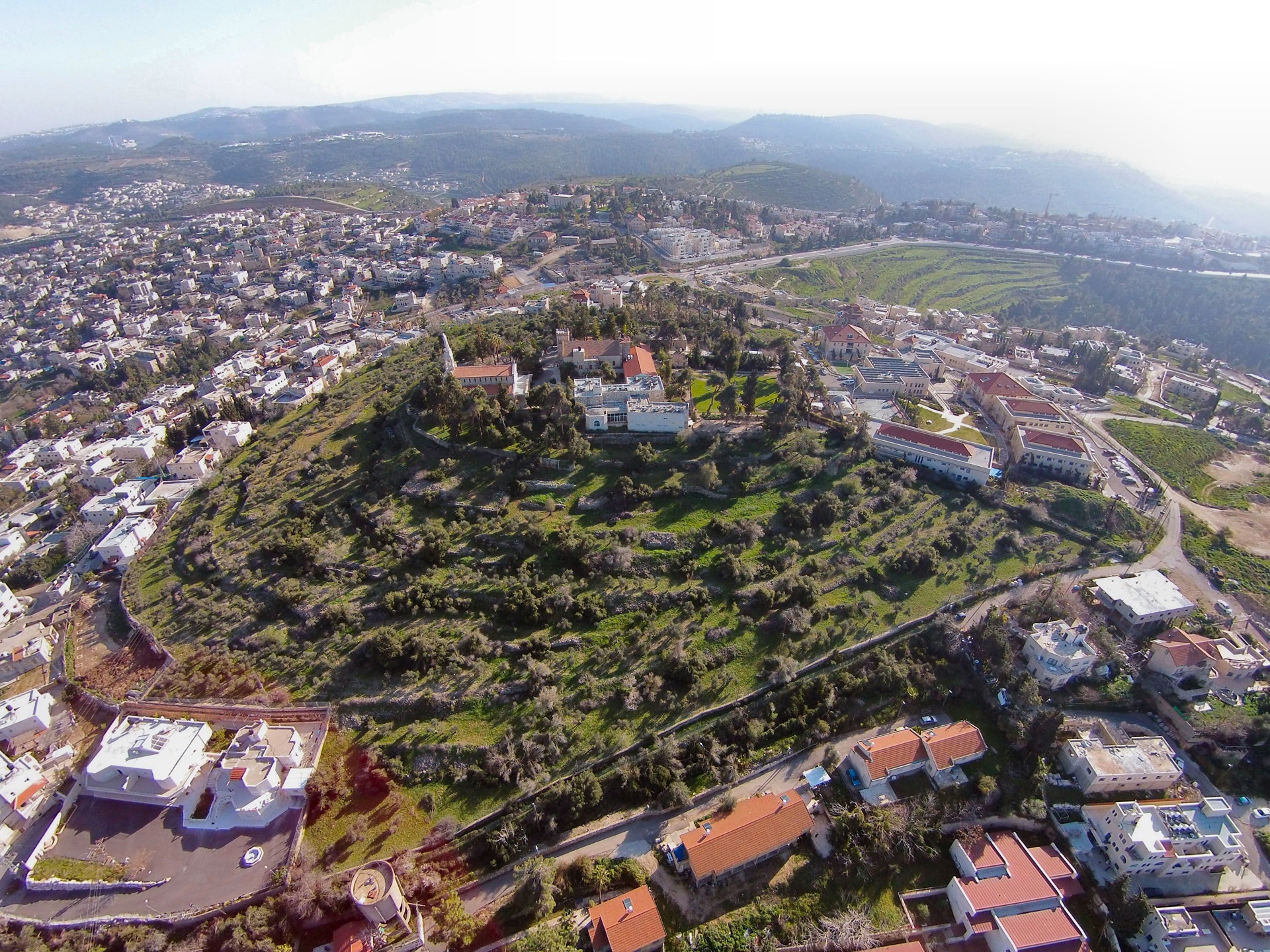
The Biblical town of Emmaus, which is linked to Jesus’ resurrection and the Ark of the Covenant, may have been found Photo: Fox News
Not yet confirmedUnder investigation. Here is what is known and what still needs proof.
Two men walked with heavy steps along the dusty road leading away from the walls of Jerusalem toward the Judean hills. It was the first day of the week, shortly after the crucifixion of Jesus of Nazareth. Overwhelmed by grief and bewildered by reports that their master's tomb was empty, the disciples were discussing recent events when a stranger approached and fell in step beside them. Upon reaching the small village of Emmaus, the visitor accepted their invitation to dinner, and as he broke bread, their eyes were opened, as recorded in the Gospel of Luke 24:13-35. For centuries, the exact location of that village has remained one of the greatest mysteries of biblical geography.
In September 2019, an international team of archaeologists presented a compelling new hypothesis that energized the academic community. Researchers from Tel Aviv University and the Collège de France announced the discovery of the remains of a massive 2,200-year-old Hellenistic fortification whose walls were repaired during Roman rule in the 1st century A.D. at the hilltop site of Kiriath-Jearim, located on the outskirts of the modern Arab village of Abu Ghosh, west of Jerusalem.
The excavation was led by archaeologists Israel Finkelstein of Tel Aviv University, along with Thomas Römer and Christophe Nicolle of the Collège de France, with financial support from the Shmunis family of San Francisco. Details of the study were presented in a paper published in the academic journal New Studies in the Archaeology of Jerusalem and its Region. According to the researchers, this large military structure could be the key to identifying the New Testament village of Emmaus.
The mystery of the village where the risen Christ broke bread
The narrative in Luke's Gospel specifies that the village of Emmaus was located about 60 stadia from Jerusalem, an ancient measurement equivalent to roughly 7 miles or 11 kilometers. This distance matches almost precisely the route between the Temple Mount in Jerusalem and the hill of Kiriath-Jearim. The biblical account describes the disciples' journey to Emmaus and their prompt return to Jerusalem that same night, a feasible trek for an 11-kilometer walk each way.
In addition to geographic distance, ancient historical accounts, including those by the Jewish-Roman historian Flavius Josephus and the books of Maccabees, describe Emmaus as a fortified town west of the Judean capital. The Seleucid general Bacchides fortified several towns surrounding Jerusalem in the 2nd century B.C. to secure the approaches to the city, and Emmaus was prominently listed among those strategic strongholds.
Archaeological finds at Kiriath-Jearim revealed that the site played a continuous military role across centuries, serving as a guard station for trade and troop movements climbing from the coastal plain to Jerusalem. This dual correspondence, matching both the 60-stadia distance and the presence of major Hellenistic and Roman fortifications, strengthened the case made by the excavators in 2019.
Ancient 2,200-year-old walls in the hills west of Jerusalem
Excavations at Kiriath-Jearim unearthed massive stone walls up to ten feet thick, originally constructed during the Hellenistic period when ancient Greek influence was dominant in the region. Speaking to the media at the time of the announcement, Israel Finkelstein explained via email to Fox News that detailed analysis of the masonry revealed subsequent repairs executed during the early Roman period, coinciding with the era of Jesus and the apostles.
The discoveries indicate that the site served as a fortress guarding the western approach to Jerusalem from the Iron Age through the Hellenistic and early Roman periods, Finkelstein explained. The archaeologist noted that these architectural remains shed light on the long-debated issue regarding the location of the New Testament's Emmaus, providing concrete physical evidence of an active military presence in the early 1st century.
Fieldwork employed advanced methods in geology, epigraphic analysis, and optically stimulated luminescence dating to establish when the stone blocks were placed. The team identified structural repairs demonstrating that the fortification was not abandoned in the 1st century, but remained operational and occupied by imperial or local garrisons during the opening decades of the Christian era.
The temporary home of the Ark of the Covenant and the defense of the capital
The hill of Kiriath-Jearim carries historical significance extending far beyond the New Testament era. In the Old Testament, the site is famous for housing the Ark of the Covenant for over twenty years. According to 1 Samuel 7:1-2, after the Ark was returned by the Philistines, the men of Kiriath-Jearim brought it to the house of Abinadab on the hill and consecrated his son Eleazar to guard the Ark of the Lord until King David eventually relocated it to Jerusalem.
In 2018, the year prior to the Emmaus announcement, Finkelstein's team confirmed that the hill outside Abu Ghosh was indeed the historical site of Kiriath-Jearim. Excavations uncovered a monumental earth platform retained by massive 8th-century B.C. walls, likely constructed by the Northern Kingdom of Israel to assert control over the Kingdom of Judah.
This layering of history highlights how the same strategic hill maintained religious and military prominence for over a millennium. The hill that sheltered the sacred symbol of God's presence during the era of the judges and kings later served as the fortress overlooking the road where the resurrected Messiah would walk alongside his followers.
Nicopolis and Motza: rival candidates in the search for Luke's Emmaus
Despite enthusiasm surrounding the finds at Kiriath-Jearim, identifying the site as biblical Emmaus is far from a settled consensus among historians and archaeologists. Other locations have competed for centuries for the title of the true village mentioned by Luke. The oldest traditional candidate is Emmaus Nicopolis, located in the Ajalon Valley roughly 19 miles (160 stadia) west of Jerusalem.
Emmaus Nicopolis became a prominent Christian center in the Byzantine period, and early Church tradition identified it with the Gospel site. However, critics point out that a 19-mile walk each way would be an exceptionally grueling round trip for disciples to complete between late afternoon and nightfall, though some ancient manuscripts of Luke do record 160 stadia instead of 60.
Another candidate frequently proposed by scholars is the village of Motza, located just 30 stadia (about 4 miles) from Jerusalem. Motza exhibits clear Roman-era settlement remains and is mentioned in rabbinic sources and by Josephus as a colony of veteran soldiers established by Emperor Vespasian. Critics of Motza argue that the distance is too short compared to the majority manuscript tradition of Luke.
Historian Benjamin Isaac of Tel Aviv University noted that Finkelstein's proposal is a geographically sound hypothesis, but remains a hypothesis. Without an inscription from the Roman period explicitly bearing the name Emmaus carved into the stones of Kiriath-Jearim, absolute scientific certainty remains elusive.
How science reads biblical texts while respecting tradition
Israel Finkelstein is widely recognized in global archaeology for advocating an evidence-based methodology that maintains a critical, analytical stance toward scriptural accounts. The archaeologist stated in 2017 that when reading the Bible, it is important to distinguish historical facts from the ideological or theological stances of the authors, an approach he applies rigorously to field excavation.
The hypothesis linking Kiriath-Jearim to Emmaus illustrates how modern archaeological research interacts with sacred geography. Archaeologists do not aim to prove miracles or validate faith through shovel work, but rather to reconstruct the physical setting and political environment in which New Testament events unfolded.
For Bible readers and students of Christian history, identifying the stones of Kiriath-Jearim provides a tangible window into the road where the disciples' hearts burned within them as the unknown traveler opened the Scriptures to them. As excavations continue, the hill of Abu Ghosh stands as a silent witness to ancient defense routes and the enduring memory of events that reshaped the world.