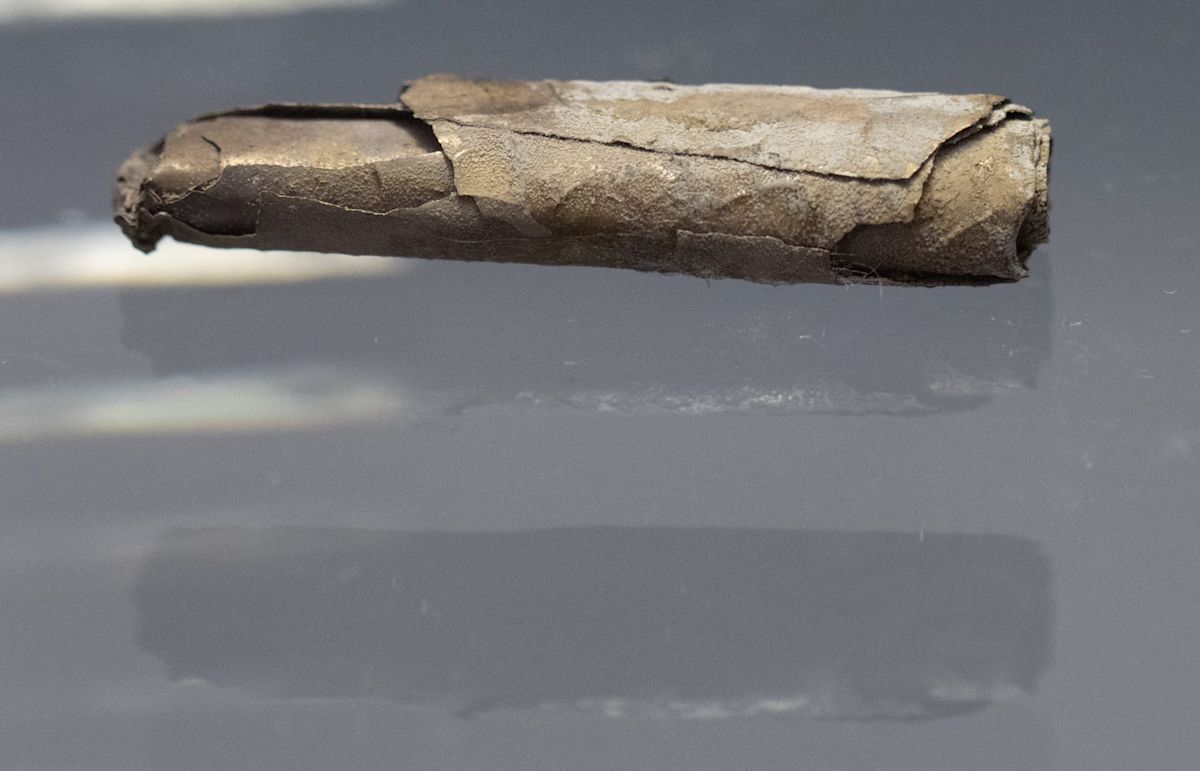
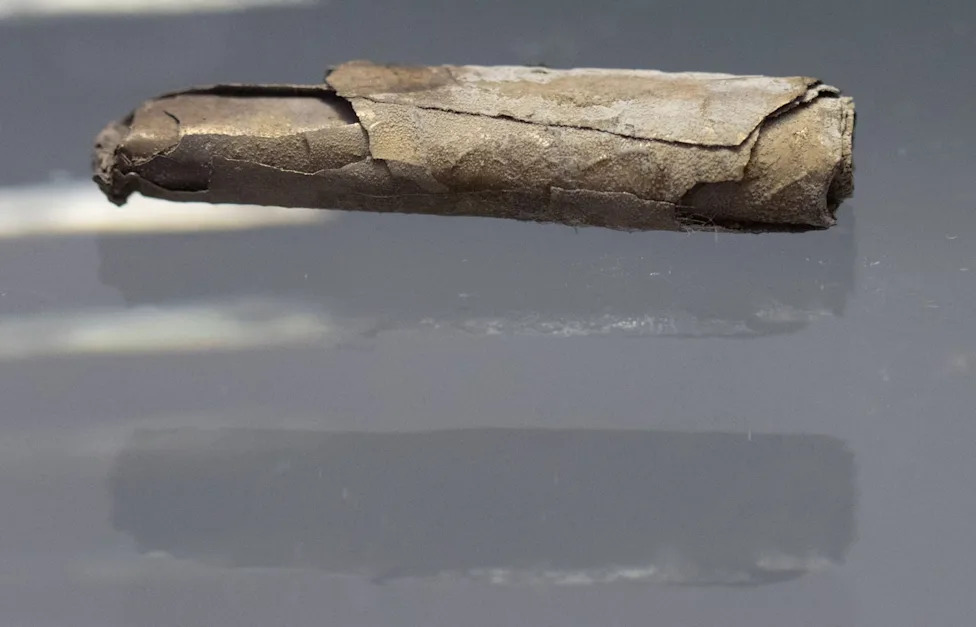
A man between 35 and 45 years old was buried in Nida, a Roman town that is now part of Frankfurt, Germany, sometime between A.D. 230 and 270, with a small silver capsule under his chin. Inside was a thin rolled sheet carrying 18 lines of Latin that ask for the protection of Jesus Christ, Son of God. The piece was excavated in 2018 and read by CT scan in 2024. The City of Frankfurt and Goethe University present it as the oldest Christian testimony found north of the Alps.
The Popular Mechanics story of October 19, 2026, which has been recirculating with the idea that the find rewrites Christianity's origin story, does not report a new discovery. It leans on a 2025 paper by Santiago Guijarro, a scholar of early Christianity at the Pontifical University of Salamanca, published in the journal Isidorianum. It is one specialist's reading of a find announced in December 2024, and its central question is what the sheet tells us about the man who wore it.
A frontier cemetery and a sheet no one could unroll
Nida grew out of a military base in the A.D. 70s, became the capital of the civitas Taunensium in the Roman province of Germania Superior, and peaked in the early third century. According to the English Wikipedia entry, which gathers the published literature, the town declined quickly from the 250s because of fighting along the frontier and stood empty by about 275 or 280. That abandonment sets the latest possible date for the amulet.
A Jesus Amulet Rewrites Early Christianitypicture alliance - Getty Images Photo: Yahoo News
The Heilmannstraße cemetery in Praunheim was excavated in 2017 and 2018 by the city's monuments office. Crews documented 127 graves across roughly 500 square meters, and 113 were inhumations, a far higher share than in Nida's other burial grounds. Grave 134 held the man's skeleton, nails suggesting a coffin, an incense burner and a clay jug. Those two objects anchor the date. The city says 230 to 270, the museum 230 to 260.
The capsule is 3.5 centimeters long and about 9 millimeters wide, with small eyelets for a cord, and it held a foil sheet 9.1 centimeters long, folded and crushed. Microscope and X-ray work showed writing in 2019, according to Goethe University, but after 1,800 years in the ground the foil would have crumbled if anyone tried to open it.
The breakthrough came in May 2024 at the Leibniz Centre for Archaeology (LEIZA) in Mainz. A high-resolution CT scan produced a 3D model, and segments were stitched together virtually until every word showed. Archaeologist Markus Scholz, an expert in Latin inscriptions, says the next idea sometimes took weeks or months to arrive. He consulted historians of theology, among them church historian Wolfram Kinzig of the University of Bonn.
Parts of the edges were lost in the soil, and the team itself says the filling of those gaps remains open to debate. The city unveiled the find on December 11, 2024, and the piece has been on view at the Archaeological Museum Frankfurt since December 18.
What the sheet says, and why the language matters
The text is Latin, in a popular cursive with capitals and lowercase letters mixed, the kind seen in graffiti and curse tablets rather than the polished hand of official monuments. Scholz calls that unusual, since amulets of this type were normally written in Greek or Hebrew.
The silver matters too. Protective texts were preferred on precious metals, while curses went on lead. Most known amulets were made of papyrus or parchment, Wikipedia notes, and the only other Christian silver amulet it cites dates to the fifth century.
The text opens with an invocation of a Saint Titus. Next comes the Greek word agios, holy, three times in Latin letters, then the formula in the name of Jesus Christ, Son of God. Jesus's name is abbreviated in the style of the nomina sacra, the reverent shorthand of Christian manuscripts. He is called lord of the world, and the text asks that the object protect the man who has surrendered to the will of the Lord, against attacks and illness, according to the published readings. The close quotes Scripture.
What struck the team was what is missing. There is no Yahweh, no archangels, no patriarchs of Israel and no demons. Goethe University points out that precious-metal amulets up to the fifth century usually blend traditions, with Jewish or pagan elements. This one, the researchers say, is purely Christian.
Each point carries caveats. Scholz's reading and Guijarro's differ in places, and because the inscription is accessible only digitally, the direction of the cuts is hard to judge, which makes some letters uncertain. Part of the text is still a hypothesis.
Philippians in Latin, Titus and the trisagion: what it touches in the Bible
The closing lines quote Philippians 2:10-11, the passage of the Christ hymn in which every knee bows in heaven, on earth and under the earth, and every tongue confesses the Lord. According to Guijarro, as summarized on Wikipedia, it is the earliest extant Latin version of the passage, only slightly later than the oldest Greek manuscripts. A Latin New Testament was already circulating in North Africa by the end of the second century, but the Latin manuscripts that survive are much later.
The details are fine-grained. Paul's Greek uses a purpose conjunction, while the sheet uses a causal "because," a formula that commonly introduces a scriptural citation. Guijarro concludes that the author treated the words as sacred text. The plural "all knees" also stresses Christ's power, which here becomes the basis of protection rather than merely the result of his humiliation.
The choice of Paul stands out, because early Christian amulets more often cite the Gospels. Guijarro reads it as pointing to a milieu tied to the Pauline tradition. The Titus at the start would be, on the prevailing hypothesis, Paul's coworker who appears in 2 Corinthians 7:6, in Galatians 2:1-3 and in the letter that bears his name (Titus 1:4-5). Guijarro, however, calls that reading puzzling, because the veneration of Titus as a saint came much later. He does not offer a firm alternative.
The trisagion, the "holy, holy, holy" of Isaiah 6:3 and Revelation 4:8, is another sensitive point. The earliest attestations on amulets were from the fifth century, and its fixed place in the liturgy from the fourth. Scholz believes the find could change the history of the liturgy. Wikipedia summarizes two possibilities: the formula may have moved from worship to amulets, which would make it much older in worship, or it may have entered popular practice on its own and only later reached the liturgy.
Then there is the tension with magic. Acts 19:19 records believers in Ephesus burning their books of magic arts. Later, a canon attributed to the Council of Laodicea barred clergy from making amulets and ordered the exclusion of those who wore them. That text is more than a century younger than the Nida burial, however, and it cannot say who made this piece.
Who was the man? Scholz, Markschies, Guijarro and Leppin
The December 2024 announcement said the wearer was clearly a devout Christian. Mayor Mike Josef said the history of Christianity in Frankfurt would have to be pushed back by 50 to 100 years, and he even suggested that the first Christian north of the Alps might have been a Frankfurter.
In February 2025, church historian Christoph Markschies, president of the Berlin-Brandenburg Academy of Sciences, and Judaic scholar Peter Schäfer published their doubts in the FAZ. Speaking to hessenschau, Markschies said no one knows whether the man of Nida was a Christian. Amulets were widespread in the third century, and a seller might have pitched one as a cure. A merchant could have brought it from Italy or Dalmatia, and famous names served magic, whether Yahweh, Osiris or Jesus Christ. According to German Wikipedia, they also noted that the folded foil would have been hardly legible to its wearer and that only a preliminary translation existed.
Scholz answered calmly. To him, what matters first is when and where the piece was made, and the inscription is unmistakably Christian. He partly agrees that amulets tend to pile up powerful names from several cultures, but insists nothing here is non-Christian. On the demand for churches or meeting rooms as proof, he noted that north of the Alps walls rarely survive and that clear places of worship are known only after 313.
Guijarro takes a middle road. In his words, the content tells us about the person who wrote the text and much less about the person who wore it. The man could have belonged to a congregation or received the object as a gift. Around 250, Emperor Decius ordered sacrifices to Rome's gods, and Cyprian of Carthage had to sort out Christians who sacrificed, those who bought certificates and those who refused. Guijarro suggests that someone only loosely tied to the church might not have seen a conflict between wearing a prayer to Jesus and performing the imperial rite. He does not claim that it happened. The boundaries of what we call Christianity, he writes, were far more porous than later church literature suggests.
Hartmut Leppin of Goethe University, according to German Wikipedia, thinks the dead man was probably local, because the family placed the amulet with care. He concedes, though, that it could have been a gift and that the man was not a Christian. Ulrich Volp of Mainz sees in the find a sign that Christianity moved along trade routes even during persecutions. Kinzig counts it among the oldest witnesses to the New Testament in Roman Germania.
Local context matters. In January 2026, according to Indian Defence Review, Goethe University announced funding to study Nida's large sanctuary, where there are offerings, remains of ritual meals and a dedication dated 246. Worshippers there honored gods including Jupiter and Apollo. That shows the town's religious setting, but it does not show that the man took part in those rites.
Where the headline overreaches
The notion that the find rewrites Christianity's origin story is an exaggeration. It does not touch first-century Judea or the texts of the New Testament. At most it moves back the earliest material trace of Christians in one region. The city itself notes that historical references to Christian groups in Gaul, and perhaps in Upper Germania, go back to the late second century. What was missing was physical proof. The first bishops known in what is now Germany, those of Cologne and Trier, appear at the synods of 313 and 314.
Three claims also need to be kept apart. The sheet is Christian in content, and that is well established. It is, according to its discoverers, the oldest Christian trace in the region, and that rests on dating by grave goods, not radiocarbon. That the owner was a devout Christian, by contrast, is a contested interpretation.
Finally, the idea of a prayer hidden in a capsule is dramatic in a headline but has an ordinary explanation. That is how amulets were worn, and the wearer probably never read the foil. What the piece truly shows is an everyday Christianity of protection from illness, tied to Paul's letters, on the empire's edge.
On the man's origin, Scholz said in February 2025 that his bones were being analyzed to see whether he was local, that the silver-lead alloy and residues such as pollen might show where the amulet came from, and that results would be published. In the sources I could open I did not find those results, nor a full peer-reviewed edition of the reading. Guijarro's paper, the museum's reading and the city's release are what is public.