Italian archaeologists discover links to tomb of Jesus underneath Jerusalem's Church of the Holy Sepulchre Photo: euronews
Not yet confirmedUnder investigation. Here is what is known and what still needs proof.
A team from Sapienza University of Rome has published its account of what lies under the floor of the Church of the Holy Sepulchre in Jerusalem: an abandoned quarry, cultivated plots and burial places cut into the rock. Euronews summed it up on October 27, 2026, under a headline saying Italian archaeologists had found links to the tomb of Jesus. The source is a 98-page preliminary report on the final excavation campaign, published in Liber Annuus, the journal of the Studium Biblicum Franciscanum. It is a field report, not the identification of a tomb. The excavations do not identify any particular tomb as the tomb of Jesus.
The project director, Francesca Romana Stasolla, told the Daily Mail: “We have found evidence of a funerary landscape.” The phrasing is careful, and it should be read that way. A funerary landscape is a group of burials in an area. It is not a named sepulcher.
A field report, not a discovery made this week
The dig grew out of a conservation job. A restoration of the church floor was planned in 2022, and it turned into an extensive excavation project. The work was approved by the three communities that manage the church (the Orthodox Patriarchate, the Custody of the Holy Land and the Armenian Patriarchate) and licensed by the Israel Antiquities Authority. To avoid disrupting services and pilgrims, the excavation was planned to run continuously, day and night, for more than two and a half years.
The abstract, posted in Sapienza's research repository, says the 2025 campaign completes the investigations in the north aisle and the Rotunda intercolumniations, which allows a first topographical synthesis of the whole complex. It describes the quarry on Gareb Hill as the foundation for everything built later, with several extraction phases, leveling of the bedrock, and agricultural and funerary reuse. It also reports new evidence on the drainage system of the early Christian complex and a first study of Iron Age pottery. There are nine authors. The paper is preliminary: documentation and materials analysis are ongoing.
Much of what the press treated as news was already public. In 2025 the Times of Israel interviewed Stasolla about traces of what once was a garden, with olive trees and grapevines, that echoed the Gospel of John. What changed is the formal publication, in a scholarly journal, of a synthesis of the whole dig.
Two points in the coverage call for caution. The first is the date. Euronews writes that traces of olive trees and vines were found, dated to around 33 AD, the period in which Jesus's death is usually placed. That goes further than the published evidence. Arkeonews points out that the archaeological context puts the remains in the pre-Christian phase of the site, but that radiocarbon dating had not yet provided such an exact date. Euronews itself concedes, further down, that the plant remains cannot yet be dated precisely. The second point is the tone of some headlines, which spoke of a “true tomb” found. The archaeologists have not recovered Jesus's body, an inscription naming him, or any other evidence that can conclusively identify a tomb as belonging to Jesus of Nazareth.
Quarry, low walls and vines: what the soil showed
The picture the report builds begins long before Jesus. The deepest layers reach the Iron Age: beneath the modern paving there are strata going back that far, with pottery, oil lamps and burials. The hill was worked as a quarry. Stasolla confirmed to the Catholic News Agency that the team documented both funerary and agricultural use before Hadrian's restructuring of the site, around 130 AD.
As stone extraction was gradually abandoned, the ground was put to other uses. Low stone walls were built and the spaces between them filled with soil, and tombs were cut into the rock as the quarry went out of use. According to Arkeonews, the analyses detected remains associated with cereals, grapes, figs and grasses, plus vine wood and pollen consistent with grape growing and possibly olives.
This is where lab work comes in. Archaeobotany studies seeds, charcoal and wood. Palynology identifies pollen. The olive and grapevine traces were identified through archaeobotanical analysis, including pollen, on samples taken from beneath the floor. Based on the archaeological context, the strata date to the pre-Christian era, and radiocarbon dating had not been done. Dating by context means the layer sits below another whose age is known. The method is accepted, but it yields a wide window. Radiocarbon would narrow it.
The site could not be opened all at once. The team divided the area into sections, excavating one at a time and covering each again. The overall view comes from digital reconstruction. Stasolla sees a match with the Gospel: “The Gospel mentions a green area between the Calvary and the tomb, and we identified these cultivated fields.”
There is a point of geography as well. According to Stasolla, there was a hill here, part of which was excavated to create a quarry, and Calvary stood above the depression the quarrying left.
What the Gospels say, and where the archaeology fits
The closest biblical text is John 19:41-42. The evangelist says that in the place where Jesus was crucified there was a garden, and in the garden a new tomb where no one had yet been laid. Because it was the Jewish day of Preparation and the tomb was close at hand, they laid him there. John 19:20 describes the place of crucifixion as near the city. In John 20:15, Mary Magdalene takes Jesus for someone tending the garden, the “gardener.”
The other Gospels add that the tomb was cut from rock. Matthew 27:57-60 describes a rich man, Joseph of Arimathea, who laid the body in his own new tomb, hewn out of the rock. Mark 15:46 and Luke 23:53 likewise say the tomb was cut in stone. Hebrews 13:12 says Jesus suffered outside the gate. Each of these details has some echo in what the dig found: ground outside the walls of the day, cultivated plots, worked rock and burials.
Stasolla has explained that “at the time of Jesus, this area was still outside the city walls,” and became part of Roman Aelia Capitolina only decades later. That fits what is known about Jerusalem, where burials lay outside the inhabited area.
There is also older evidence than the current dig, which many scholars consider the strongest. Inside the basilica, in a Syrian chapel west of the Rotunda, are other first-century tombs, with burial shafts (kokhim) clearly from the time of Christ's death, which attest to a burial ground in the area. In a 2022 Times of Israel podcast, archaeologist Jodi Magness of the University of North Carolina at Chapel Hill points to two Jewish burial niches as proof that this was a cemetery in the time of Jesus, and therefore outside the city. She calls it the closest archaeology comes to establishing the authenticity of the site, though she says nothing is unambiguous.
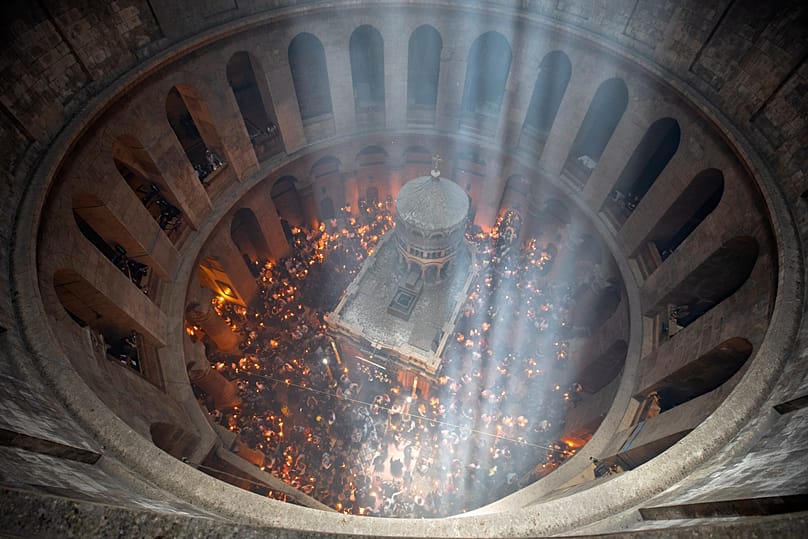
Christian pilgrims hold candles as they gather in the Church of the Holy Sepulchre in Jerusalem's Old City. Copyright 2021 The Associated Press. All rights reserved. Photo: euronews
Constantine, the fourth century and a mortar dated to 345
The site has layers of history that the excavation helps separate. After the destruction of Jerusalem in AD 70 and Hadrian's refounding of the city around 130, the original site of the Constantine-era church was a repurposed pagan temple built by Hadrian. The site has been recognized since early in the fourth century as the place where Jesus was crucified, buried and rose from the dead, and the church was consecrated on September 13, 335.
The strongest scientific data on the tomb itself came from the 2016-2017 restoration of the Aedicule, the shrine around the venerated rock. The National Technical University of Athens team, led by Antonia Moropoulou, subjected mortar samples to optically stimulated luminescence tests, which show when quartz grains were last exposed to light. The mortar connecting the slab to the bedrock was dated to 335-345 AD. Archaeologist Martin Biddle told National Geographic that the date is spot-on for whatever Constantine did. The results appeared in the Journal of Archaeological Science: Reports, in 2018. National Geographic's coverage noted that it remains impossible to prove archaeologically that the tomb is the place where Christ was buried.
The Sapienza dig adds pieces to this phase. The 2023 report recorded that the apse of the early Christian church was found, beneath which runs a Roman street. According to Arkeonews, a large circular marble base turned up beneath the Aedicule, and the team suggests the feature may belong to Constantine's original treatment of the venerated tomb. The round shape is notable because some early depictions show the shrine as a circular structure. Coins of Constantius II and Valens found in the Rotunda place the associated activity in the fourth century.
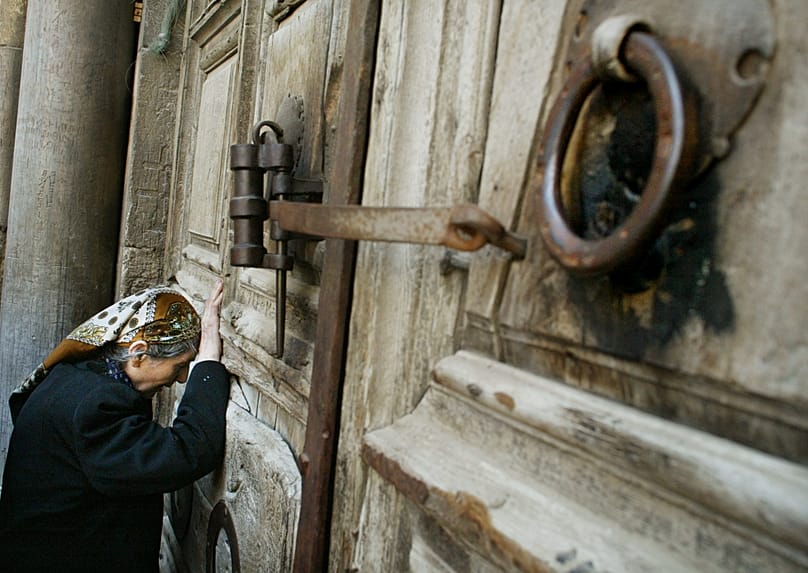
A Christian pilgrim prays in front of the doors of the Church of the Holy Sepulchre in Jerusalem's Old City. KEVIN FRAYER/AP Photo: euronews
What the skeptics say, and the three-hundred-year gap
The critics' central argument is not that the report is wrong. It is that the link to Jesus rests on a chain of memory archaeology cannot reach. Magness sums it up on the podcast: many scholars think the church is probably the authentic spot because the tradition is so ancient, but there remains a gap of roughly three hundred years between the crucifixion and Constantine, which she calls a leap of faith archaeology cannot cross. The remark dates from 2022, before the 2025 report, and is not a reaction to it. In the sources I consulted, I found no published rebuttal from other specialists aimed specifically at this report.
Euronews, in its own text, lists the limits. There is no inscription to that effect, nor can it be shown that the tomb chamber was unused or belonged to Joseph of Arimathea. Arkeonews adds that no archaeological method can identify the occupant of the traditional tomb with certainty. The garden, for that matter, is a match of landscape: the report does not claim that this cultivated ground is John's garden.
There is also an older debate over the site. Archaeologists Shimon Gibson and Joan Taylor, in their 1994 book on the area, had already concluded that the entire area had been an Iron Age quarry, characterized by irregular rock cuttings, scarps and caves. Taylor further argues that, in its present form as a rock finger, it would have been logistically impossible for three people to be crucified on top of it. The point shows why historians treat Golgotha with care, even when they accept the general location.
As for the popular alternative, the Garden Tomb, the objection is chronological. It was not a “new tomb in which no one had yet been laid” (John 19:41); it was already over 600 years old by the time of Jesus. And it was not identified as the tomb of Jesus until the 19th century.
The project director herself keeps the planes apart. Asked whether the find echoes John 19:41, Stasolla agreed, but drew a line between archaeological research and theology.
What this changes for readers of the Gospels
The report's contribution is different from what the headline suggests. It does not prove that Jesus was buried there. It shows that the site Christians have venerated since the fourth century has geographical and archaeological features that match the New Testament descriptions. Euronews says as much when it writes that the site venerated by Christians for centuries has features that correspond to the descriptions in the New Testament. Compatible is not the same as confirmed, and a reader who knows the texts understands the difference.
For readers of John, the gain is context. The garden, the rock-cut tomb, the place outside the city and the nearness of the execution site stop being details without a landscape and acquire ground that actually existed, a few yards from where millions of pilgrims now pray. The question the stone cannot answer, which cavity was used and by whom, remains a question of history and of faith.
The next steps are measurable. The plants still need radiocarbon dates. The first volume of the Hagia Polis Project on the Holy Sepulchre excavations, devoted to project and methodology, was edited by Stasolla in 2026. And she has cautioned that the work is still in progress and the study will reserve many surprises.
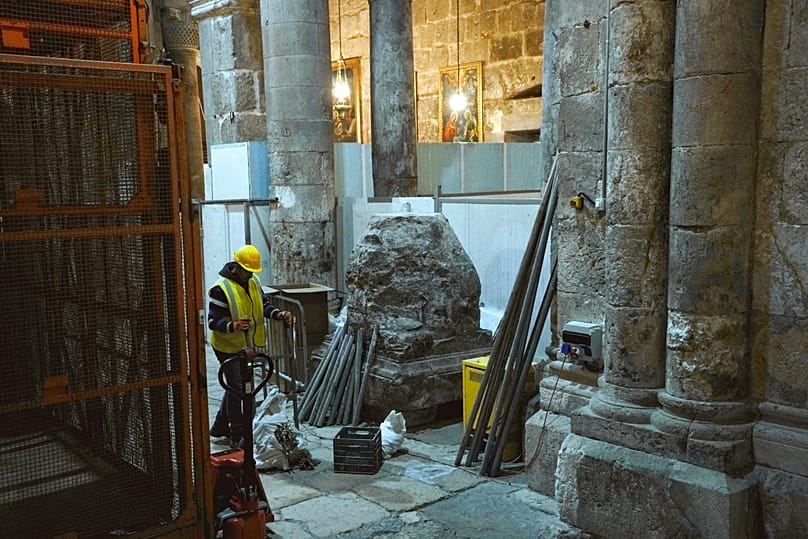
A member of the restoration team works on the floor of the Church of the Holy Sepulchre, where many Christians believe that Jesus was crucified, buried and rose from the dead. Copyright 2022 The Associated Press. All rights reserved Photo: euronews
A Sapienza University of Rome team published a 98-page preliminary report in Liber Annuus on its 2025 excavation under the Church of the Holy Sepulchre.
The report documents a quarry with several extraction phases, agricultural and funerary reuse, and rock-cut tombs on ground that lay outside the walls in Jesus's day.
No inscription, body or other evidence identifies any tomb as Jesus's; mortar in the Aedicule was dated to about 335 to 345 AD.
The olive and grapevine remains were placed in a pre-Christian phase by context, not by radiocarbon.
What we don't know yet
The exact age of the plant remains, since radiocarbon results have not been published.
Whether the venerated chamber was a new, unused tomb, and whether it belonged to Joseph of Arimathea.
How the memory of the place was passed down over the roughly three hundred years between the crucifixion and Constantine.
How other specialists will receive the report, since I found no published responses to it.