Jesus "appeared alive on the third day": new study reopens the mystery of a 2,000-year-old text by a Jewish historian
Written around AD 93, the most controversial passage by Flavius Josephus survives in four different versions. A Spanish researcher compared them all to find out what the historian really said.
Not yet confirmedUnder investigation. Here is what is known and what still needs proof.
This week, the Daily Mail and the New York Post ran stories suggesting that a 2,000-year-old text contains a written account of Jesus' resurrection. There is something real behind the headlines, but it is not a discovery. No scroll, papyrus or inscription has turned up. What exists is a study by Jesús Fernández-Pedrera Correa, an independent Spanish researcher, posted on August 15, 2026, as a preprint: a paper anyone can read that has not yet been reviewed by other specialists.
The text he examines has been known for centuries, and it may be the most argued-over paragraph in all of ancient history. Scholars call it the Testimonium Flavianum, "the testimony of Flavius," and it sits in Josephus' Jewish Antiquities, book 18, sections 63 and 64. To see why a new study of it makes news, it helps to know who wrote it, what it says, and why scholars have fought over it for four hundred years.
Who Josephus was
Yosef ben Matityahu was born in Jerusalem around A.D. 37 into a priestly family. When the Jews revolted against Rome in 66, he commanded the rebel forces in Galilee. Trapped at the town of Jotapata in 67, he surrendered and told the Roman general Vespasian that he would become emperor. The prediction came true, Josephus was freed, and he took the imperial family's name: Flavius.
Living in Rome, he wrote the books that remain our main source on first-century Judea. The Jewish War, finished around 75, tells the story of the revolt and the destruction of the temple in 70. The Jewish Antiquities, completed around 93 or 94, retells the history of the Jewish people from creation to the eve of the war. Herod, Pontius Pilate, John the Baptist, the high priest Annas and James the brother of Jesus all appear in its pages. Anyone who reads the Gospels and then Josephus recognizes the setting: the same places, the same rulers, the same tensions.
Josephus never became a Christian. He wrote as a Jew, for Greek and Roman readers, defending his people's dignity after a lost war. That is what makes his words about Jesus valuable, and it is also what makes the surviving text so odd.
What the passage says
In the Greek form that has come down to us, the paragraph calls Jesus a wise man, "if indeed one ought to call him a man," who did surprising deeds and taught people who received the truth gladly. It says he won over many Jews and many Greeks. Then comes the sentence at the center of the dispute: "He was the Christ." The passage says Pilate condemned him to the cross after an accusation by the leading men, that those who loved him did not give up, and that he appeared to them alive again on the third day, as the prophets had foretold. It ends by noting that the "tribe" of Christians, named after him, has not died out.
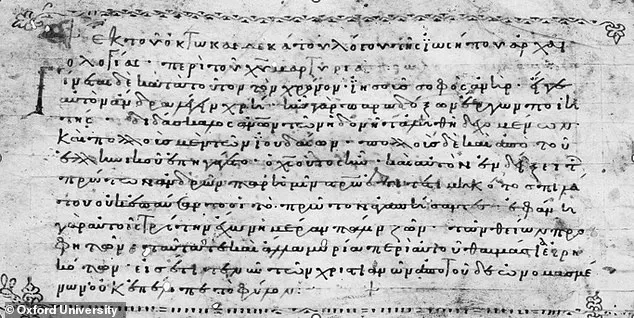
The Testimonium Flavianum in a Greek manuscript of the Jewish Antiquities. Photo: Oxford University
Read that way, it sounds like a confession of faith, and that is the problem. Origen, a third-century Christian writer who knew Josephus' work well, noted twice that Josephus did not accept Jesus as the Christ. It would be hard to write that if the copy in front of him said, flatly, "He was the Christ."
Three positions on one paragraph
Since the 16th century, scholars have split into three camps. Some consider the passage entirely authentic. Others consider it an outright Christian forgery; Ken Olson has even argued that its author was Eusebius of Caesarea, the first writer to quote it, in the early fourth century.
The most common view today sits in the middle: partial authenticity. Josephus wrote a neutral paragraph about Jesus, and Christian copyists later added or touched up the most theological lines. Supporters of this view point out that phrases like "wise man" and "surprising deeds" fit Josephus' vocabulary and sound unlike Christian writing, while "He was the Christ" sticks out.
A second, stronger argument comes from elsewhere in the Antiquities. In book 20, Josephus reports that in 62 the high priest Ananus, son of the Annas of the Gospels, had "the brother of Jesus who was called Christ, whose name was James" stoned. Nearly all specialists accept that line as genuine. It mentions Jesus in passing, as someone the reader already knows, which suggests Josephus had introduced him earlier. The natural place for that introduction is book 18.
Why the manuscripts can't settle it
The trouble is that we don't have what Josephus wrote, only copies of copies. The oldest Greek manuscript of book 18 that contains the passage, held at the Ambrosian Library in Milan, dates to the 11th century, a thousand years after the author. Before that, the text appears in quotations by Eusebius around 320, already in its current form. More than two centuries separate Josephus from Eusebius with no witness in between.
The manuscripts also show how freely copyists handled the text. An early 15th-century copy of the Jewish War, known as Codex Vossianus, has the Testimonium inserted into a book where it never belonged, next to the story of Pilate. No one argues that Josephus put it there. It is a visible example of how a paragraph can wander through a copying tradition.
Because the Greek alone isn't enough, Fernández-Pedrera Correa compares four lines of transmission, four separate routes by which the paragraph reached us. Besides the Greek, he looks at Jerome's Latin quotation from around 392; an Arabic summary in the chronicle of Agapius of Hierapolis, a 10th-century bishop; and a Syriac version in the chronicle of Michael the Syrian, a 12th-century patriarch. The Arabic and Syriac versions came to scholars' attention in 1971, when the Israeli scholar Shlomo Pines published them.
All three non-Greek lines handle the Messiah sentence the same way. Jerome writes that Jesus "was believed to be the Christ." Michael the Syrian says "he was thought to be the Messiah." Agapius says he "was perhaps the Messiah." For the author, when witnesses in different languages and centuries agree against the Greek, the simplest explanation is that the Greek was changed. That, he argues, is the only Christian alteration the text's history lets us demonstrate with any confidence.
The resurrection enters his conclusion more cautiously, and this is where the headlines overreached. In the Arabic version, the appearance after the crucifixion is presented as something the disciples reported: they said Jesus had appeared to them three days later and was alive. The author finds it plausible that Josephus recorded what Jesus' followers claimed to have seen, as he does elsewhere with the beliefs of Jewish groups he did not share, and that copyists later turned that report into a direct statement. He acknowledges that the surviving versions don't allow anyone to reconstruct Josephus' wording line by line.
The objections
Two cautions help put the study in proportion. Alice Whealey, who has studied the Testimonium for decades, argues that the Arabic and Syriac versions both descend from a single Syriac translation of Eusebius. If so, they are not two independent witnesses to Josephus but two descendants of the same text, and their agreement counts for less. Whealey herself, however, also concludes that the original read something like "he was believed to be the Christ," which points in the same direction as the new study.
The second caution is that the debate is very much alive on both sides. In 2025, T. C. Schmidt published a book with Oxford University Press arguing that the passage is essentially authentic, with little or no tampering. On the other side, some scholars still regard nearly the whole paragraph as a later addition. A preprint by an independent researcher enters that conversation as a contribution to be tested, not as the last word.
What it means for Bible readers
If the hypothesis holds, it does not prove the resurrection, and the author doesn't claim it does. A historian recording what a group says it saw is not vouching that it happened. What the study suggests is something else, and historically interesting: that a Jewish historian writing in Rome about sixty years after the crucifixion knew the disciples claimed to have seen Jesus alive after his death.
That lines up with what the New Testament had recorded decades earlier. Around A.D. 55, Paul wrote to the Corinthians listing the people Jesus appeared to, including "more than five hundred brothers and sisters at the same time, most of whom are still living" (1 Corinthians 15:3-8). In other words, the disciples' claim predates the Gospels and was known inside and outside the church.
Josephus isn't the only outside voice, either. Around 116, the Roman historian Tacitus wrote that the name "Christians" came from Christ, who was executed by Pontius Pilate during the reign of Tiberius. A few years earlier, Pliny the Younger, a Roman governor in Asia Minor, described to the emperor Trajan Christians who met before dawn to sing hymns to Christ "as to a god." None of them was sympathetic to the faith. That body of evidence is why the vast majority of historians, believers or not, treat Jesus' existence and crucifixion as historical facts.
Fernández-Pedrera Correa's study doesn't change that picture. It offers a sharper portrait of one paragraph, and the next step is to see how other specialists respond.